Local-first evidence for coding agents

Evidence before edits.

Open Kioku turns a repository into an evidence layer: exact symbols, ranked context, impact, tests, history, architecture, and verification — so agents can plan from facts instead of guessing from file crawls.

Read-only by default No hosted code index MCP over local stdio
Index onceSQLite + BM25 facts
Plan firstEvidence-backed boundaries
Edit normallyYour agent stays in control
Verify afterCheck what actually changed
Measured on large repositories

Repository intelligence that survives contact with real code.

The 3.0.4 release was tested end to end on a large Java repository, with the workload, timings, and caveats reported below.

Cold structural index
14m44s
9,312 indexed files, 136,212 symbols, 136,646 chunks, 211,057 graph nodes, and 707,271 graph edges. A repeat full rebuild completed in 8m 22s with identical totals.
3.82s
exact class lookup, fresh process
272,858
local semantic vectors · 0 failures
67,810
tests indexed
58
MCP tools with routing + safety metadata
Measured, not promised: timings come from one local workstation and vary with hardware, repository shape, Git history, and enabled evidence. Four concurrent graph reads completed without lock failures; optional compiler-grade SCIP evidence was unavailable for this build and remained explicitly reported as missing. Inspect the JSON evidence ↗ Read the method and caveats ↗
Release-linked evidence

Don’t take the marketing copy on faith. Inspect the proof.

The evidence below identifies the immutable Open Kioku 3.0.4 release, publishes aggregate results, and keeps caveats beside the claims they qualify.

Immutable release identity

Open Kioku 3.0.4, tested at scale.

A concise visual summary of the release identity, large-Java workload, and observed quality checks. The adjacent artifacts are the source of record.

84ca3d0 source11,404 tracked files0 semantic failures
Machine-readable evidence

Auditable without exposing the repository.

The JSON records release source, host profile, configuration, command shapes, workload totals, measurements, quality checks, and limitations. Repository identity and revision are withheld, so exact replay is not claimed.

136,212 symbols707,271 edges4 parallel readers
Inspect JSON evidence ↗
Method + limitations

Quality means preserving uncertainty.

The repeated structural run reproduced identical totals, exact identities ranked first, and graph queries used indexed anchors. Missing compiler-grade SCIP evidence remained visible instead of being treated as present.

0 lock failures0 failed vectors
Read methodology ↗
Evidence boundary: these are single-workstation observations, not latency guarantees. Publishing an anonymous workload protects the test target but prevents exact source-level reproduction.
One evidence pipeline

From repository facts to the smallest useful context.

Open Kioku combines deterministic code intelligence with explainable retrieval signals. Exact repository facts do not get demoted by a fuzzy match.

01
Indexsymbols, chunks, tests, graph
02
Retrievelexical + local semantic context
03
Provereferences, history, runtime, coverage
04
Planfiles, boundaries, validation
05
Verifychanged files against the plan
exact symbolsreferencesBM25local semanticimpact graphtestsgit historyruntimecoveragearchitecturecontracts
EX

Facts outrank guesses

Definitions, references, paths, and exact evidence stay authoritative. Heuristics can help retrieval without rewriting repository truth.

authority ≠ score
CTX

Context with a purpose

Ranked snippets, exact line ranges, impact, nearby tests, and caveats give the next agent step a bounded evidence set.

search → context → plan
ANN

Scales locally

Optional semantic retrieval stays on-device and can use persistent approximate nearest-neighbor search while exact-flat remains the correctness oracle.

local semantic · no hosted index
HIS

History is evidence

Co-change, churn, ownership, reviewer, provenance, renames, and similar-change signals are derived from bounded local Git history.

local history enabled by default
VAL

Tests before edits

Validation candidates are selected from indexed tests and repository evidence before a change begins, not as an afterthought.

plan with validation targets
VFY

Verification closes the loop

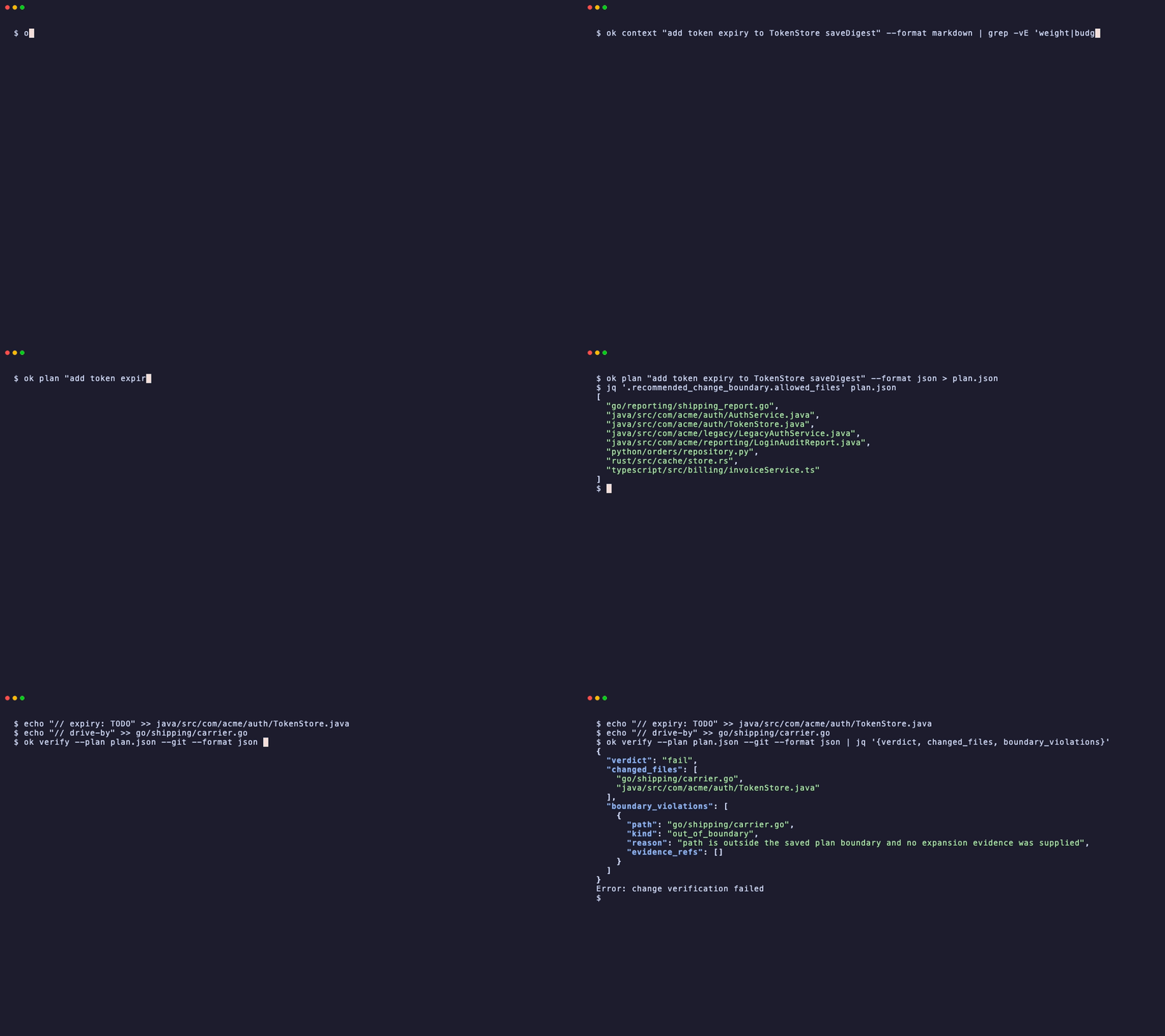
Plans define edit boundaries. Verification compares the actual changed files with those boundaries and reports evidence caveats.

plan → edit → verify
Interactive product tour

A coding workflow with memory of what matters.

Click through the same sequence an agent can use before, during, and after a repository change.

ok plan
Local by design

Your repository is the source of truth — and it stays yours.

The default workflow is designed for local repository intelligence rather than a hosted code-index service.

No hosted index

Core search and evidence are stored under the repository’s local .ok/ data.

Read-only by default

The MCP server provides evidence tools; source edits remain in the normal editor and agent workflow.

Network-denial posture

Default MCP security configuration includes network denial; local semantic search does not require a hosted embeddings API.

Share proof, not source

ok prove reports index and validation signals while intentionally omitting source snippets.

Evidence stays honest: runtime traces and coverage reports are optional local inputs; when evidence is missing, Open Kioku reports the caveat instead of pretending certainty.
Start with your own repository

Give your coding agent evidence before the next edit.

Install locally, build the repository index, then generate a plan from the task you actually care about.

$ npm install -g open-kioku
If Open Kioku improves your agent workflow, consider starring the repository ↗.